We Should Talk...
A Sermon about the promise of peacemaking with our Abrahamic siblings while war is waged in Gaza.

August 25, 2025
I wasn’t sure how best to frame the posting of this sermon, shared three months ago. It’s not meant to be a credo on the War in Gaza; it’s certainly not a set of policy recommendations. It isn’t even a prophetic claim about the morality of war.
It’s more of a lament—with a little bit of hope thrown in. It is meant for the Christians in the audience to consider, though it certainly talks about issue facing Jewish and Muslim siblings. Even when—or perhaps because—bombs fall, killing civilians and physicians and journalists, I feel there needs to be a little bit of hope, and a constructive way forward, even if not heavy on detail.
A third narrative (see below for more detail), so to speak.
I have dear friends and colleagues—scholars, activists, ministers, whose approaches are quite different, and I have a lot of respect for the way they analyze, accompany, and advocate.
But this is what I have to offer.
And it starts with a vision.
During the night Paul had a vision: there stood a man of Macedonia pleading with him and saying, "Come over to Macedonia and help us."
When he had seen the vision, we immediately tried to cross over to Macedonia, being convinced that God had called us to proclaim the good news to them.
We therefore set sail from Troas and took a straight course to Samothrace, the following day to Neapolis, and from there to Philippi, which is a leading city of the district of Macedonia and a Roman colony. We remained in this city for some days.
On the Sabbath day we went outside the gate by the river, where we supposed there was a place of prayer, and we sat down and spoke to the women who had gathered there.
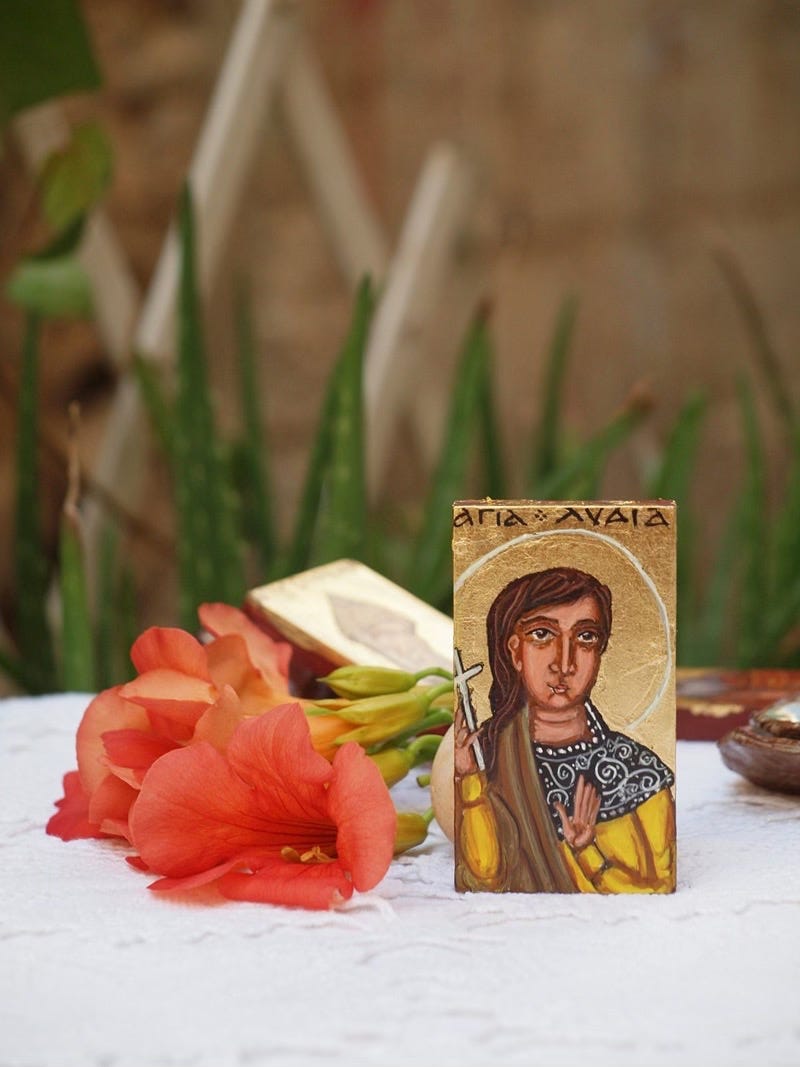
A certain woman named Lydia, a worshiper of God, was listening to us; she was from the city of Thyatira and a dealer in purple cloth. The Lord opened her heart to listen eagerly to what was said by Paul.
When she and her household were baptized, she urged us, saying, "If you have judged me to be faithful to the Lord, come and stay at my home." And she prevailed upon us.
—Acts 16:9-15
May 25, 2025:
We should talk about a couple of things.
At 9 PM, this past Wednesday in Washington, DC, Sarah Milgrim and Yaron Lischinsky were murdered just outside an event for young professionals at the Capital Jewish Museum hosted by the American Jewish Committee. Milgrim and Lischinsky were both employees of the Israeli Embassy, planning on becoming engaged, from what I understand, and as ambitious, idealistic young people, came to their work in diplomacy with the hopes of contributing to a lasting peace, a sustainable solution to the ongoing conflict between Palestinians and Israelis. They were regulars at interfaith gatherings, and had even begun exploring the Christian tradition more intently, worshipping regularly with an Episcopal congregation.
The Suspect, after being apprehended, claimed that he killed Milgrim and Lischinsky for the sake of the liberation of the Palestinian People. Though they weren’t chosen randomly, he did not know Milgrim and Lischinsky. He did not know that Milgrim was a regular at interfaith gatherings and had clear commitments to dialogue, peacemaking, and in finding a better path forward for Israelis and Palestinians.
It was a tragic, horrifying event that played out in public.
I was, of course, reminded that we still, as a nation, lack the moral courage to enact any serious policy addressing gun violence.
But I was also reminded of how, in October 2023, just after Hamas attacked, killed, and took Israelis hostage in a brazen, violent attack that took the world by surprise, a 6 year old Palestinian American child, Wadea Al Fayoume, was stabbed 26 times by his landlord—
Because Wadea was Palestinian.
Because Wadea was Muslim.
I was reminded of the 2018 murder of eleven members of the Tree of Life Synagogue in Pittsburgh, PA, targeted because they were Jewish; and I was reminded of the 2019 murders of 51 Men, Women, and Children at the Al Noor Mosque and Linwood Islamic Centre in Christchurch, New Zealand.
All Killed because they were muslims, and the gunman could not abide that.
And as I read more about last Wednesday’s shooting, I discovered that Sarah Milgrim had grown up in Overland Park, KS, the same community where my wife founded her treatment center. I learned that Milgrim attended the same Overland Park synagogue that a friend of mine, now a Rabbi, had grown up in, and that a time of mourning was held at Overland Park’s Jewish Community Center—the site of a 2014 hate crime which killed three people, none of whom were Jewish, but whom the shooter assumed were.
And I was reminded not only of the images of the 2023 Hamas attack, but of the ongoing images of the destruction and humanitarian crisis in Gaza—violence committed on a massive scale. The war in Gaza is complicated, but we just want to reduce the war to something that can be easily answered by asking simple questions:
Who are the good guys?
Who are the bad guys?
But Jesus doesn’t call us to easy or simple. Jesus calls us to love. Our Neighbors. Our Enemies. One Another.
So…yeah…I think we should talk about some things.
—
And the first thing we should talk about is Lydia.
If you followed the story in Acts, you know that the Apostle Paul meets Lydia in Phillipi, A Roman Colony in Greece. Upon hearing Paul tell the story of Jesus, she and her entire household are baptized.
Because of this, we often hear Lydia referred to as the first European follower of Jesus, though people didn’t think of themselves as “European,” at that time, certainly not in the way that we now think about what it means to be European or Asian or Australian or African or American. Our modern continents weren’t how our ancient forbears organized geography or defined themselves against one another.1
BUT as the centre of gravity for the church shifted over the centuries—from Judea to Rome and Greece, and as Empires rose and fell, and a different understanding of identity and geography began to emerge, this story took on a certain importance.
This often became a story not of how Lydia became part of the Church, but of how the church itself migrated, not just geographically, but away from its cultural cradle—the story of Lydia became a story of how the church left its Near Eastern, Jewish Roots behind and became a European Institution. In this telling, Lydia was the first European convert to Christianity, but hardly the last. Her story became a way for the European Church to trumpet its supposed superiority over Judaism.
Lydia’s story isn’t the only bit of scripture that gets used that way, of course.
I’m sure there are things that echo through your mind that you’ve heard or learned over the years:
Like how the God of the Old Testament is cruel and judgmental but the God of the New Testament is loving and forgiving (when there’s plenty of violence AND plenty of forgiveness to go around in both Testaments!).
Or how Judaism is a religion of works that is backward-thinking while Christianity is a forward-thinking religion of grace (When there is as much grace in Judaism’s understanding of who God is as there is in Christianity, and while the Church has a bad habit of turning grace into something you have to work for, instead of something that is freely given.).
All of which feed an understanding of a Christianity that sees itself as superseding—or replacing—Judaism. Christians have historically learned to see Judaism—and Jewish People—as an obstacle—or even an enemy—of the work of the church.
And whether it’s ingrained tropes and stereotypes that shape Christian language about Jews and Judaism, or crusades and gas chambers, we know what using stories like Lydia’s to trumpet Christian superiority can do.
—
There’s another way to look at Lydia’s story. We learn a lot about her in just a couple of sentences—things that may defy our stereotypes of women in the first century. After all, she’s what we might describe as an entrepreneur—not only a dealer of fine purple cloth, but she is the head of her own household, supporting a family with her earnings, and clearly having the moral—and other types of—authority to persuade her family to join her in the early Jesus movement, but there’s a quick detail in her story that is important to hear.
She is described as a “Worshipper of God” or “God-Fearer,” depending on the translation you’re reading. Now, on first hearing, that description might not mean a lot to you—it seems to only describe how faithful she was, how pious she was.
But “Worshipper of God” was a very specific term. It meant that she was not Jewish but that she had, at some point in her life, begun to worship the God of Abraham. She was a gentile who had found beauty in Judaism, adopted many of its practices, and discovered a God who loved and welcomed her. Her embrace of that God certainly doesn’t hold her back from doing anything in her context.
And she found, when she heard Paul’s preaching of the Gospel, not a refutation of what she had discovered in following the God of Abraham, but a confirmation; She heard the same welcome of the same God, but in a new way. She did not reject the Judaism she had been exploring, but she found herself grafted onto it, as Paul describes in some of his letters, like a new branch on an already existing tree. Both in her time as a “Worshipper of God” and then as a “Follower of Jesus,” Lydia experienced God’s love and God’s welcome.
Lydia’s story can remind us of something particularly tragic about Christian anti-semitism: We lose sight of the fact that so much of what we practice as Christians is inherited from Ancient Judaism and shared with our contemporary Jewish siblings—there is continuity, not conflict. Our hopes, our work, our ministry, is more interwoven than we think.
—
And that takes me to the other thing we should talk about.
Judaism is not the only sibling faith of the Church. The God of Abraham is the God worshipped by our Muslim siblings, as well, though their tradition understands scripture, the nature of worship, the identity of Jesus, and many things very differently—but the histories, the call, and the hopes—of the Church and Islam—are as interwoven as those of the Church and Judaism. We are three traditions, grafted one to another—not identical, but in many ways, inseparable. Not only in the tragedies and the wars and the stereotypes and misconceptions that have marked our shared history, but our hopes, our work, our ministry—as Jews, Christians, and Muslims—are intertwined and inseparable, as well.
We often focus on the conflict—but there is continuity, too.
Sarah Milgrim, the young jewish woman from Kansas who fell in love with the Episcopal liturgy and who loved to share a meal with her Muslim friends and colleagues—Sarah, who died way too soon, knew that. In a recent essay by a Yasmina Asrarguis, a Muslim colleague of Milgrim, wrote that Sarah was committed to a concept known as the “third narrative.”
As Asrarguis writes:
It’s a vision that seeks to rise above the noise of vengeance and violence by focusing instead on shared humanity and the mutual right to dignity, safety and peace for Jews and Muslims. This effort is about more than dialogue; it’s a deliberate stand against polarization. Sarah believed in creating a space for people to look for solutions. Like countless idealistic young people from across the three Abrahamic faiths all over the world working in public service, in ministry, Sarah believed in creating a space for people to look for solutions.
And of course, the tools for us to do so are all there. If we look in the right places, we can know the same thing Milgrim knew: That the solutions lie in the continuity that connects our faiths:
There’s a Hebrew phrase our Jewish siblings use to describe how our interwovenness becomes ministry: Tikkun Olam—“Repairing the world.” In the Jewish tradition, Tikkun Olam is a call to respond to the spiritual and physical needs of all people and all of creation, through peacemaking, justice-building, and reconciliation.
In Islam, there’s a similar concept—Islah, which translates as “Reform,” and is often used to describe a moral imperative to do justice, work for reconciliation, and build peace—Reforming the world so it looks more like what God wants it to look like.
And we, as Christians every week, when we pray together the prayer that Jesus taught us to pray—we pray that God’s will—God’s vision for peace and reconciliation—might be done on earth as it is in heaven. Every week, following in the footsteps and repeating the words of Jesus, we pray for reform and repair, just like our Muslim and Jewish siblings.
And on our best days, we work for it.
—
It has long been my prayer that Christians, as the middle child among the Abrahamic sibling faiths, might have a unique, important word of reconciliation to share, even in the face of the devastating violence last week that took the lives of Sarah Milgrim and Yaron Lischinsky, the devastating violence committed by Hamas in October of 2023, and the devastating violence waged by the Israeli military since then, all of it a harsh echo of the violence of past wars, of colonialism, of uprisings, seemingly playing out in an infinite loop when we watch it on our screens.
I keep praying that Christians, as part of our call, might at last stop believing that grace is a rare commodity that we must compete for, and instead of demonizing or dismissing our siblings, we might learn, and inspire others, to truly and fully love:
Love Our Interfaith Siblings.
Love Our Neighbors
Love Our Enemies
Love One Another
Just as we love ourselves.
So that a repaired, reformed Earth might look more like heaven.
That remains my prayer.
I hope it is yours, too. And if it is, we should talk about it.